
What Is Work Hardening?
Work Hardening is a structured rehabilitation program that prepares you to resume job duties after an injury. The program combines physical conditioning, task practice, and work-related problem solving. Activities reflect the demands of your occupation, such as lifting, reaching, standing, walking, or maintaining a safe work pace.
Quick Facts About Work Hardening
Category
Work-focused rehabilitation
Used for
Returning to physical job duties
Common confusion
General exercise or conditioning
Also called
Work Hardening Program, Work Conditioning
Often discussed with
Work Injury Treatment
Key Takeaways About Work Hardening
- Job tasks guide the program, not exercise alone.
- Progress is based on safe performance and work demands.
- Work Hardening is not the same as general fitness training.
How Work Hardening Works
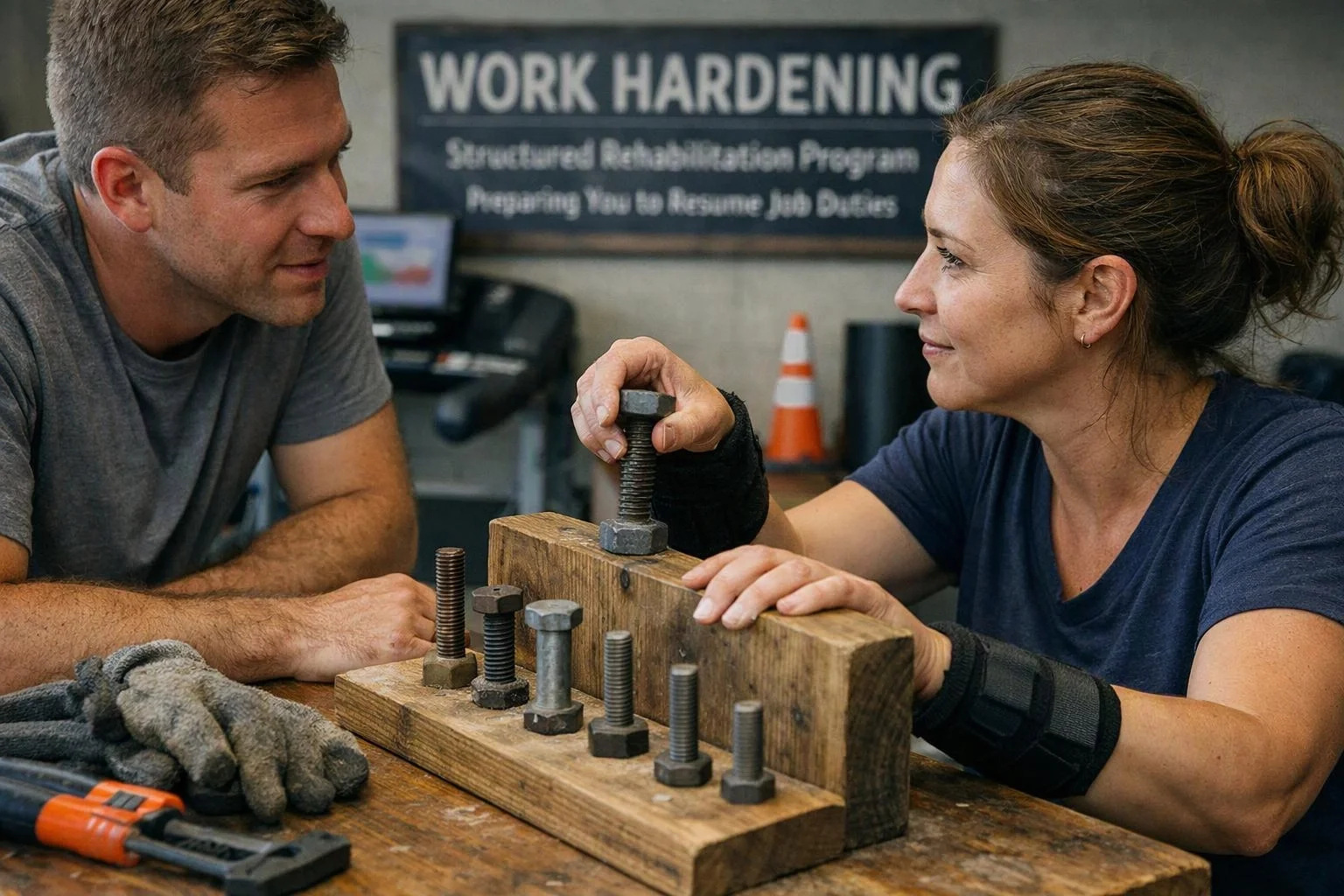
Work Hardening links rehabilitation activities to the physical and mental demands of a specific job. A program may include lifting, carrying, pushing, pulling, reaching, gripping, or sustained positions. The clinician adjusts the activity based on movement quality, symptoms, fatigue, and task performance.
Related glossary terms: Biomechanics, Gait Analysis, Range Of Motion.
Work duties shape the practice so the person can build capacity in a controlled setting. A worker may rehearse equipment handling, body positioning, pacing, and safe movement strategies that match the job. Progress focuses on completing necessary tasks with better control and tolerance, while the plan changes when the job demands or physical response changes.
From the Advanced Injury Care Clinic team
When we assess Work Hardening, we connect the reported job demands with movement, strength, endurance, and symptom responses. Our team watches how a person performs work-like tasks and adjusts the plan to address control, pacing, and tolerance. We also document functional changes that may help guide return-to-work decisions.
Work Hardening in Practice: A Real-World Example
A warehouse worker recovering from a back injury may practice lifting a light container from floor level to a shelf. The program can add carrying, reaching, and repeated position changes as the worker demonstrates better control and tolerance.
Related Services
Related Terms
Biomechanics
Biomechanics is the study of how forces, movement, and body structures interact during physical activity. The…
Gait Analysis
Gait Analysis is a clinical assessment of how you walk or run. It examines movement patterns…
Range Of Motion
Range Of Motion is the amount of movement available at a joint or body region. Clinicians…
Proprioception
Proprioception is the body’s sense of position, movement, and force without relying on vision. Sensors in…
Advanced Injury Care Clinic
Have Questions About Work Hardening?
Contact Advanced Injury Care Clinic for practical guidance on Work Hardening and related chiropractor work in Nashville.