
What Is An Adhesion?
An adhesion is a band of scar-like connective tissue that causes nearby tissues to stick or glide less freely. Adhesions may develop after injury, inflammation, surgery, or repeated strain. In musculoskeletal care, the term describes restricted tissue movement that may contribute to stiffness, altered motion, or discomfort during movement.
Quick Facts About Adhesion
Category
Connective tissue restriction
Used for
Describing limited tissue glide
Common confusion
Often confused with a trigger point
Also called
Scar tissue adhesion, Tissue adhesion
Often discussed with
Dry Needling
Key Takeaways About Adhesion
- Adhesions limit normal movement between nearby tissue layers.
- Dry needling may address related muscle tension and trigger points.
- An adhesion is not the same as a trigger point.
How Adhesion Works
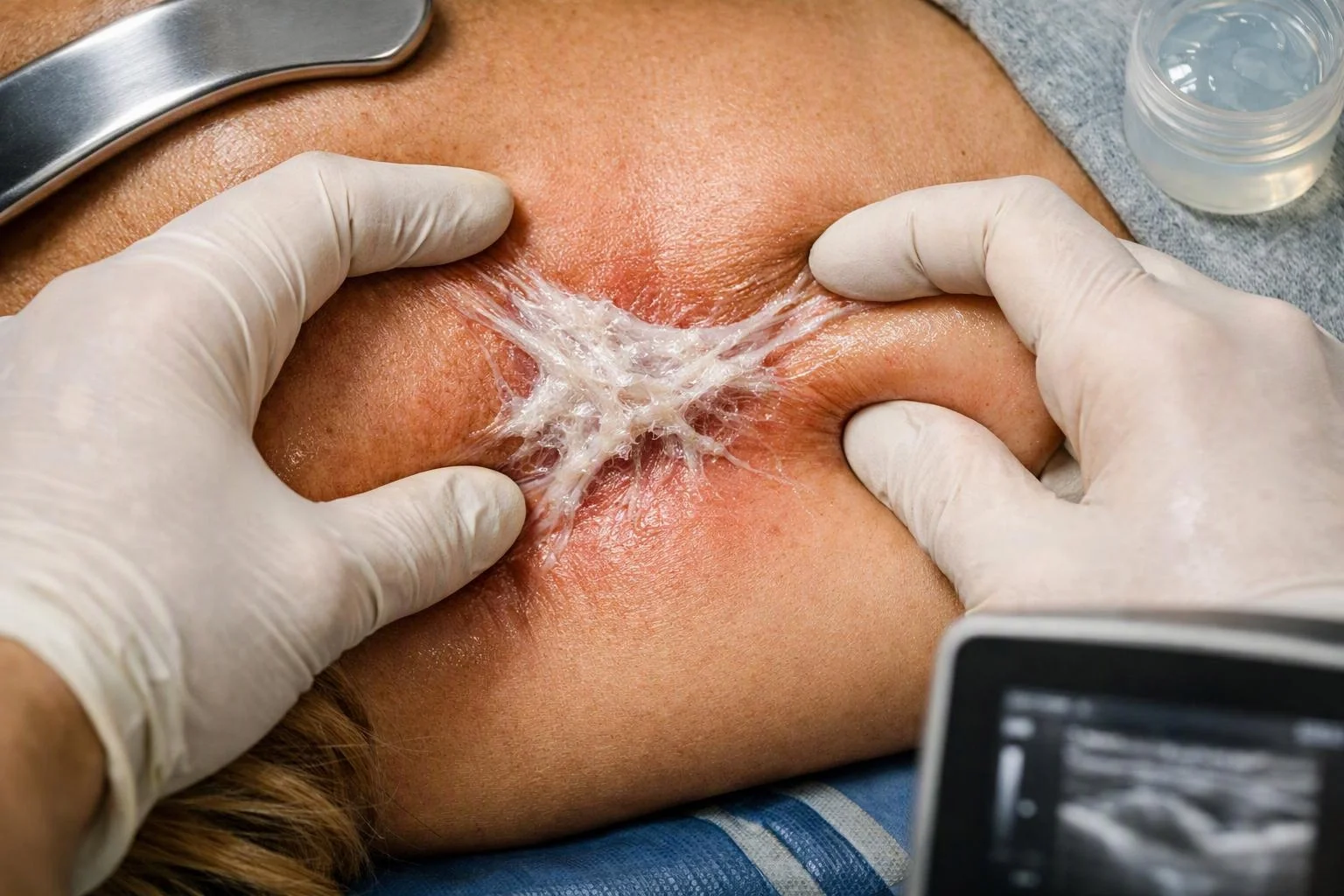
Adhesion affects how tissue layers move against one another. Connective tissue normally allows muscles, fascia, and other structures to glide during motion. After irritation or healing, tissue fibers may become less mobile and create a feeling of tightness or restriction.
Related glossary terms: Trigger Point, Myofascial Pain, Range Of Motion.
A clinician considers the location, texture, movement, and symptoms linked with the restriction. Dry needling may target nearby muscle tension or trigger points that affect movement around the area. Needling does not automatically remove an adhesion. Treatment may be combined with movement assessment and guided exercises that help restore normal tissue motion.
From the Advanced Injury Care Clinic team
When we assess a suspected adhesion, we compare tissue movement with the person’s symptoms and functional limits. During Dry Needling, we focus on related muscle tension and trigger points while tracking changes in motion and comfort. We do not treat the word alone, because the surrounding tissue pattern guides clinical decisions.
Adhesion in Practice: A Real-World Example
A person develops shoulder stiffness after an injury and feels pulling when reaching overhead. During Dry Needling, the clinician may address nearby muscle tension and trigger points while checking whether shoulder movement becomes easier.
Related Services
Related Terms
Trigger Point
Trigger Point is a sensitive area within a muscle or its surrounding fascia that may produce…
Myofascial Pain
Myofascial Pain is a muscle and connective tissue pain pattern linked to sensitive areas within tight…
Range Of Motion
Range Of Motion is the available movement at a joint or group of joints, measured through…
Mechanoreceptor
A mechanoreceptor is a sensory receptor that detects physical forces, including pressure, stretch, vibration, and movement…
Advanced Injury Care Clinic
Have Questions About Adhesion?
Contact Advanced Injury Care Clinic for practical guidance on Adhesion and related chiropractor work in Hendersonville.