
What Is Nociceptive Pain?
Nociceptive Pain is pain caused by activation of specialized nerve endings called nociceptors after actual or potential tissue injury. The signal may arise from inflammation, pressure, heat, or mechanical strain. Nociceptive pain commonly affects muscles, joints, ligaments, tendons, skin, or other tissues and often changes as the affected area heals.
Quick Facts About Nociceptive Pain
Category
Tissue-related pain
Used for
Pain assessment
Common confusion
Nerve pain
Also called
Nociceptor pain
Often discussed with
Pain management physician
Key Takeaways About Nociceptive Pain
- Nociceptors respond to tissue irritation or injury.
- Pain location often matches the affected tissue.
- Nociceptive pain is not the same as nerve pain.
How Nociceptive Pain Works
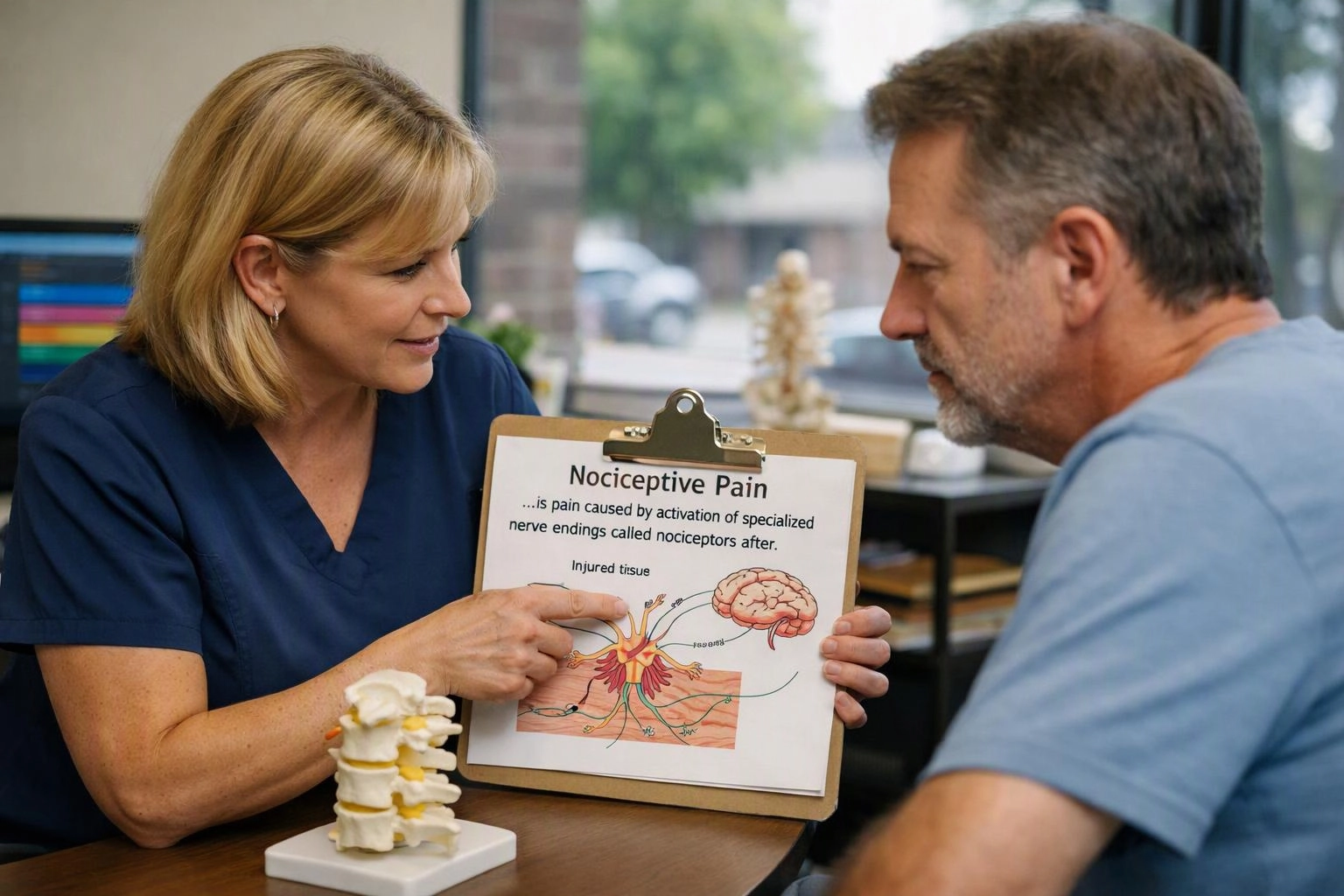
Nociceptive Pain begins when nociceptors detect a chemical, thermal, or mechanical threat in body tissue. These receptors send signals through peripheral nerves to the spinal cord and brain, where the signals become a conscious pain experience. The nervous system can increase or reduce the signal as the condition changes.
Related glossary terms: Myofascial Pain, Tendinitis, Radiculopathy.
Clinicians assess this pain by considering its location, quality, triggers, and relationship to movement or touch. Muscle strain, joint irritation, and tendinitis can produce local symptoms that fit this pattern. Nociceptive pain differs from radiculopathy, which involves irritation or compression of a nerve root and may cause symptoms along a nerve pathway. The distinction helps guide the clinical examination and the choice of care.
From the Advanced Injury Care Clinic team
When we evaluate nociceptive pain through our Pain management physician service, we connect the reported symptoms with movement, touch, and the involved body region. Our team also checks whether the pattern suggests tissue irritation or nerve involvement, because those findings can require different clinical decisions.
Nociceptive Pain in Practice: A Real-World Example
A person with an irritated knee joint may feel aching pain that increases during weight-bearing movement. In a Pain management physician visit, the examination considers the knee's motion, tenderness, and symptom pattern to identify whether local tissue irritation fits the presentation.
Related Services
Related Terms
Myofascial Pain
Myofascial pain is a regional pain condition that begins in muscle tissue or the fascia surrounding…
Tendinitis
Tendinitis is irritation and inflammation of a tendon, the strong connective tissue that attaches muscle to…
Radiculopathy
Radiculopathy is a nerve root condition that causes pain, numbness, tingling, or weakness along the path…
Trigger Point
A trigger point is a sensitive, tense area within muscle or surrounding fascia that can produce…
Advanced Injury Care Clinic
Have Questions About Nociceptive Pain?
Contact Advanced Injury Care Clinic for practical guidance on Nociceptive Pain and related chiropractor work in Nashville.