
What Is Arthrokinematics?
Arthrokinematics is the study of small joint surface movements that occur as a larger body movement takes place. These movements include rolling, gliding, and spinning between joint surfaces. Clinicians use the concept to understand how joint motion supports range of motion, coordinated movement, and corrective exercise planning.
Quick Facts About Arthrokinematics
Category
Joint movement science
Used for
Movement assessment and exercise planning
Common confusion
Not the same as gross body movement
Also called
Joint surface motion
Often discussed with
Corrective Exercise Therapy
Key Takeaways About Arthrokinematics
- It focuses on joint surface motion, not just visible limb movement.
- Exercise selection may account for how a joint glides during motion.
- Arthrokinematics is not the same as overall range of motion.
How Arthrokinematics Works
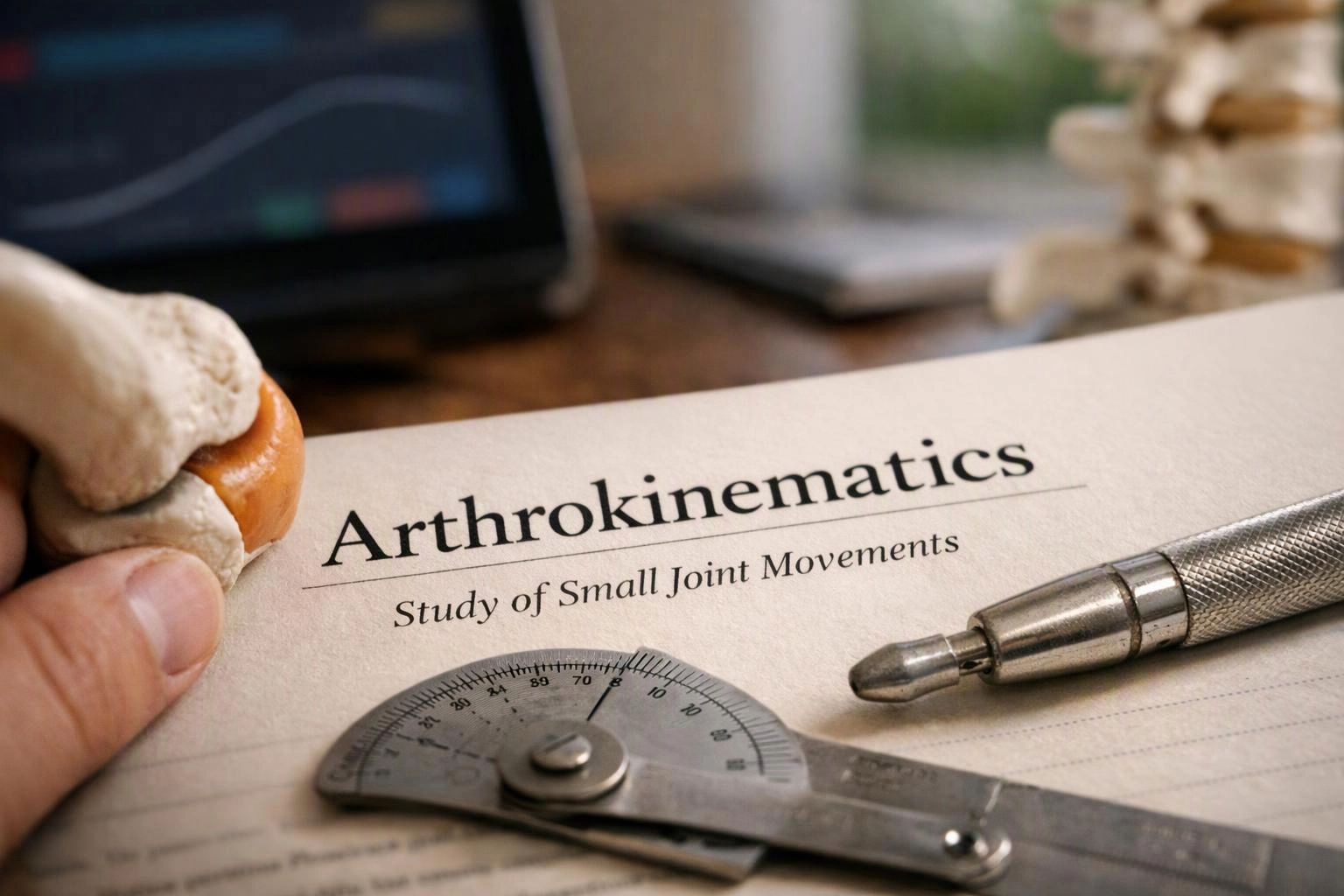
Arthrokinematics describes the contact movements between joint surfaces during motion. A joint may roll as one surface moves across another, glide as the contact point shifts, or spin around a relatively fixed area. These small actions occur within larger movements such as bending a knee or raising an arm.
Related glossary terms: Joint Mobilization, Range Of Motion, Proprioception.
Movement professionals consider joint shape, surface direction, and available motion when observing these patterns. Range of motion describes how far a body part moves, while arthrokinematics describes the surface motion that helps produce that movement. In corrective exercise therapy, these observations can guide exercise position, movement direction, and control. A person may reach overhead with limited comfort even when visible movement appears adequate, so the joint surface pattern can add useful detail to the assessment.
From the Advanced Injury Care Clinic team
When we assess movement for corrective exercise therapy, we observe how a joint surface appears to roll, glide, or rotate during the task. We compare that pattern with the person’s control, comfort, and available motion. Our team then selects exercises that match the movement goal and the person’s current ability.
Arthrokinematics in Practice: A Real-World Example
During a corrective exercise for shoulder elevation, the clinician watches the arm and shoulder blade while considering how the shoulder joint surfaces move. The exercise may be adjusted to improve control of the motion without forcing a larger range.
Related Services
Related Terms
Joint Mobilization
Joint Mobilization is a hands-on manual therapy technique that applies controlled movement to a joint to…
Range Of Motion
Range Of Motion is the available movement at a joint or group of joints, measured through…
Proprioception
Proprioception is the body's awareness of joint position, movement, and force without relying on sight. Sensory…
Facet Joint
A facet joint is a small synovial joint at the back of the spine that connects…
Advanced Injury Care Clinic
Have Questions About Arthrokinematics?
Contact Advanced Injury Care Clinic for practical guidance on Arthrokinematics and related chiropractor work in Hendersonville.